One of the main aims and biggest benefits of the National Wilding Conifer Control Programme is the joining together across regions for coordination of information, resources and expertise to manage wilding conifers.
Information is quickly shared nationally about infestations and the best way to tackle them. Regular meetings and workshops bring together the government agencies, councils, contractors and community Trusts to discuss challenges and share learnings and opportunities.
Control operations are planned within Management Units (explained below) that can cross regional and property boundaries, with all interested parties connected in through regional Councils. Health and safety management, good practice guidance, policy development, research and education are all supported through the National Programme, led by a small team within Biosecurity New Zealand.
This brings consistency where needed and it means similar work does not need to be repeated from scratch within every region.
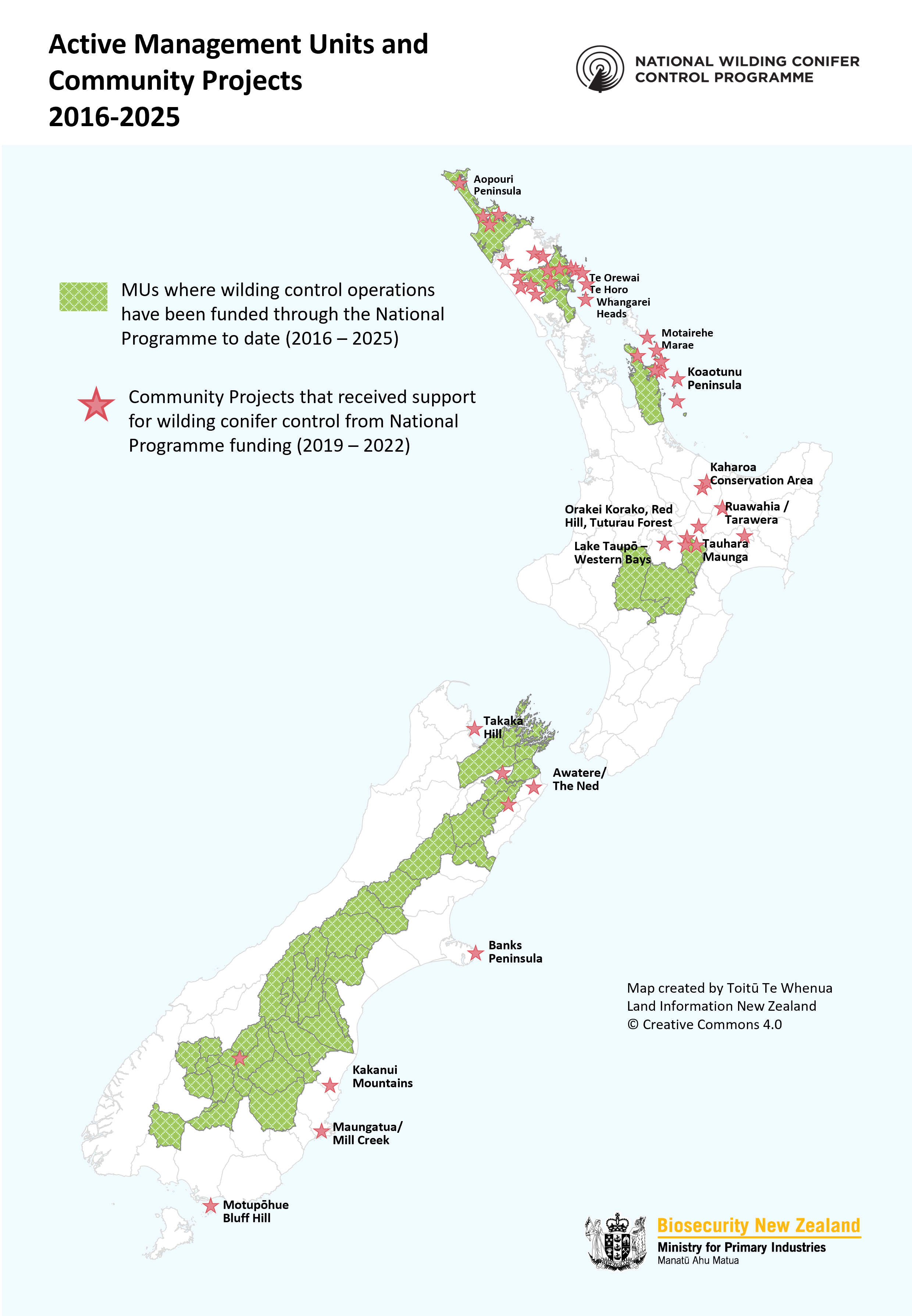
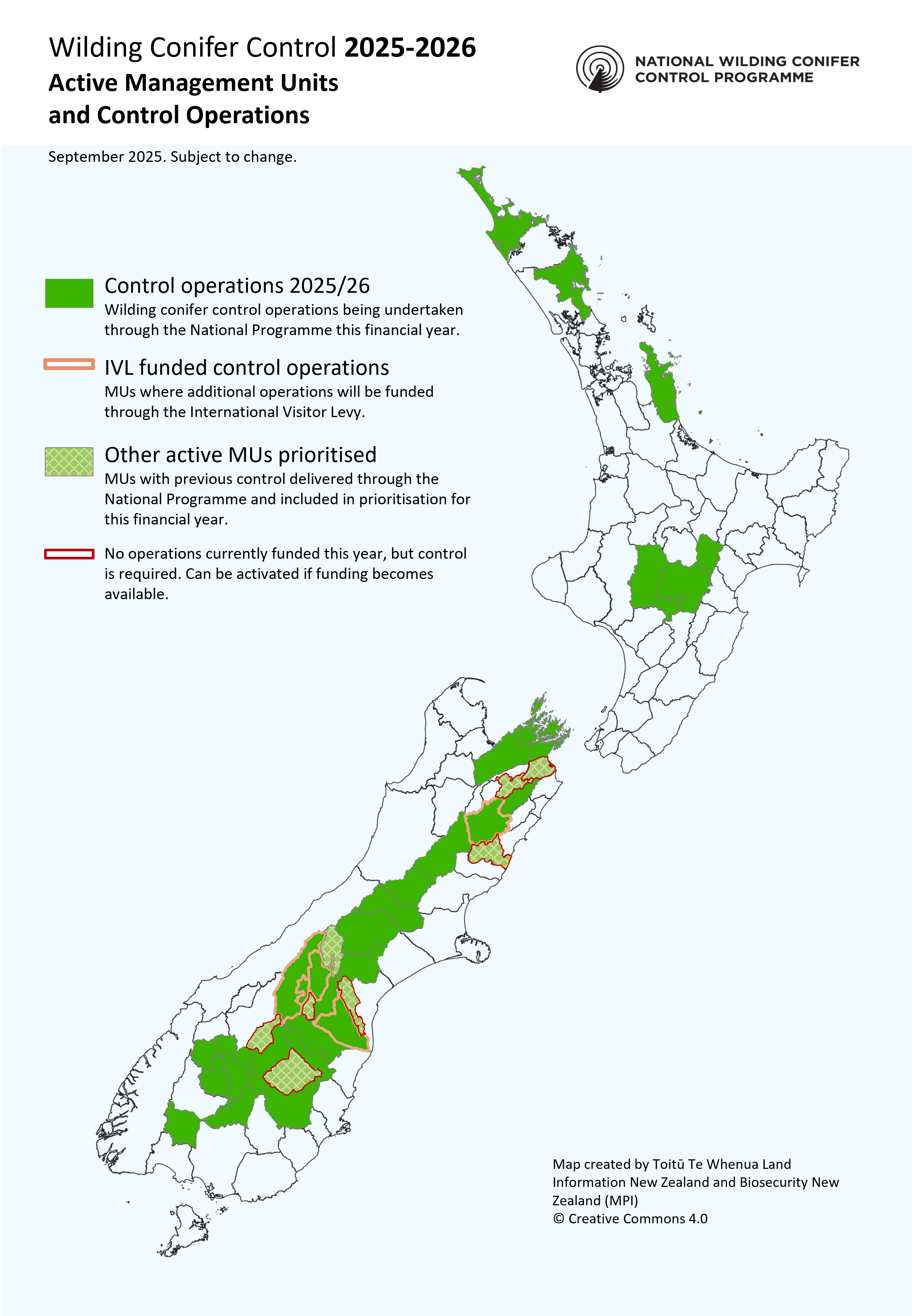
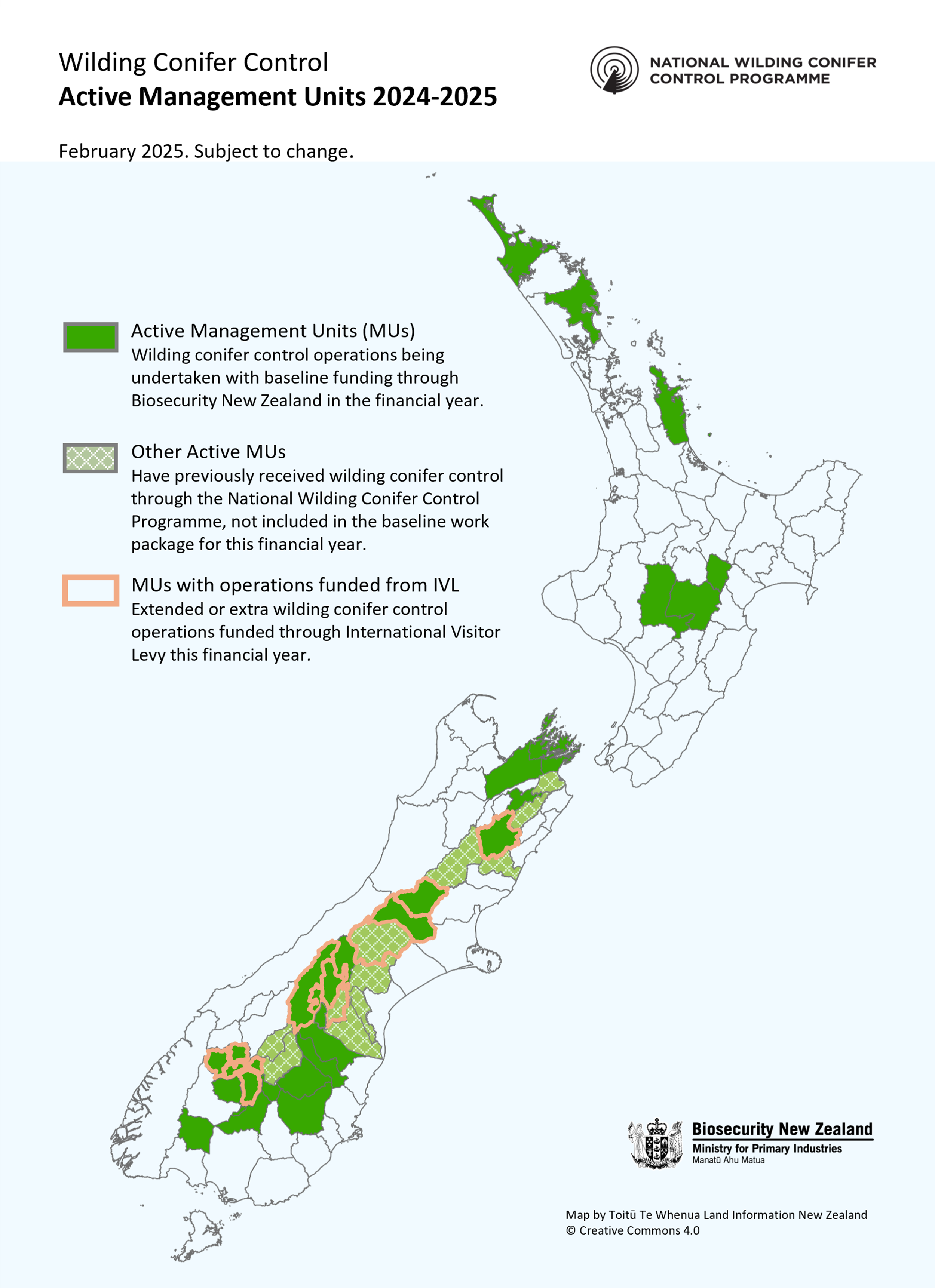
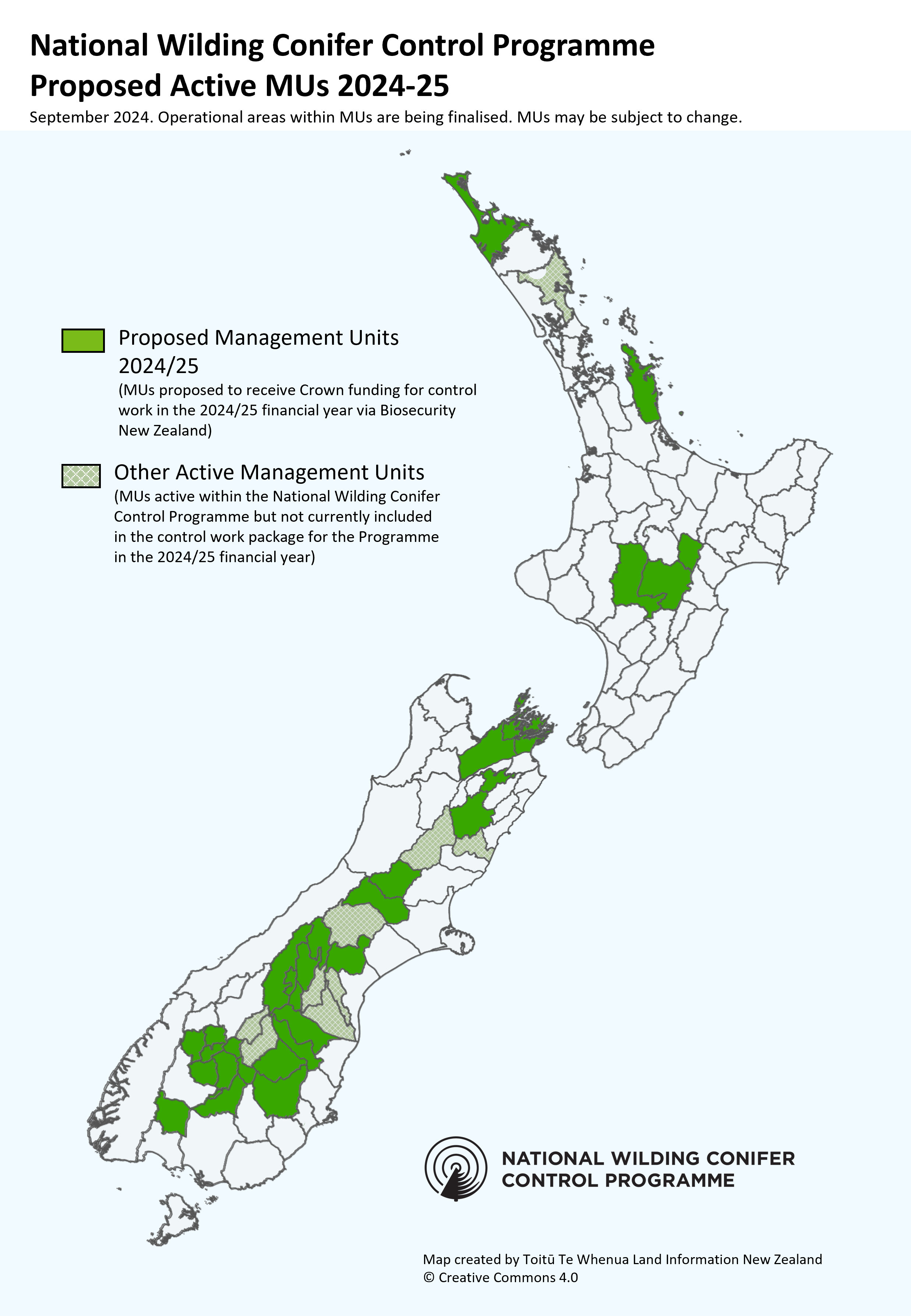
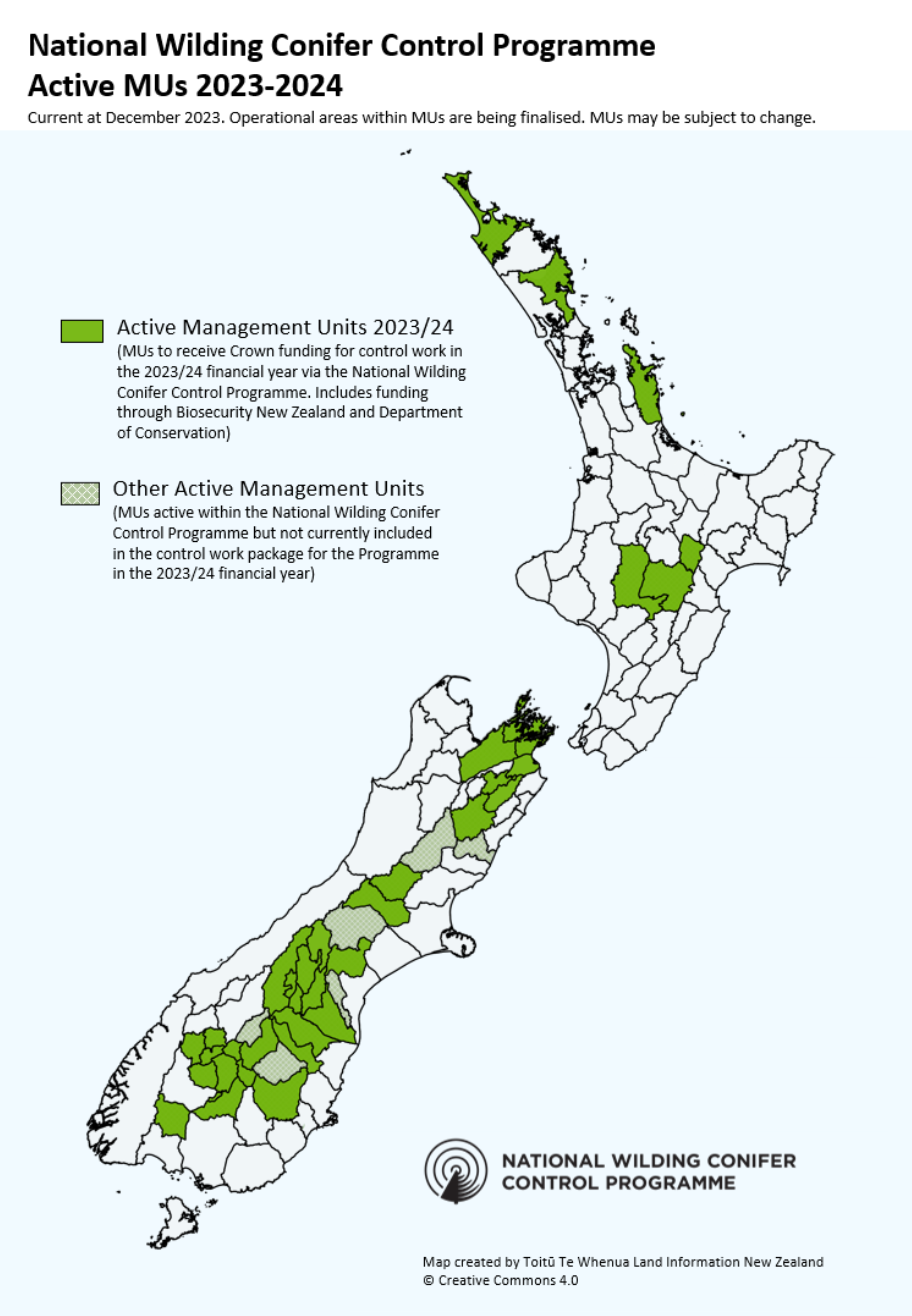
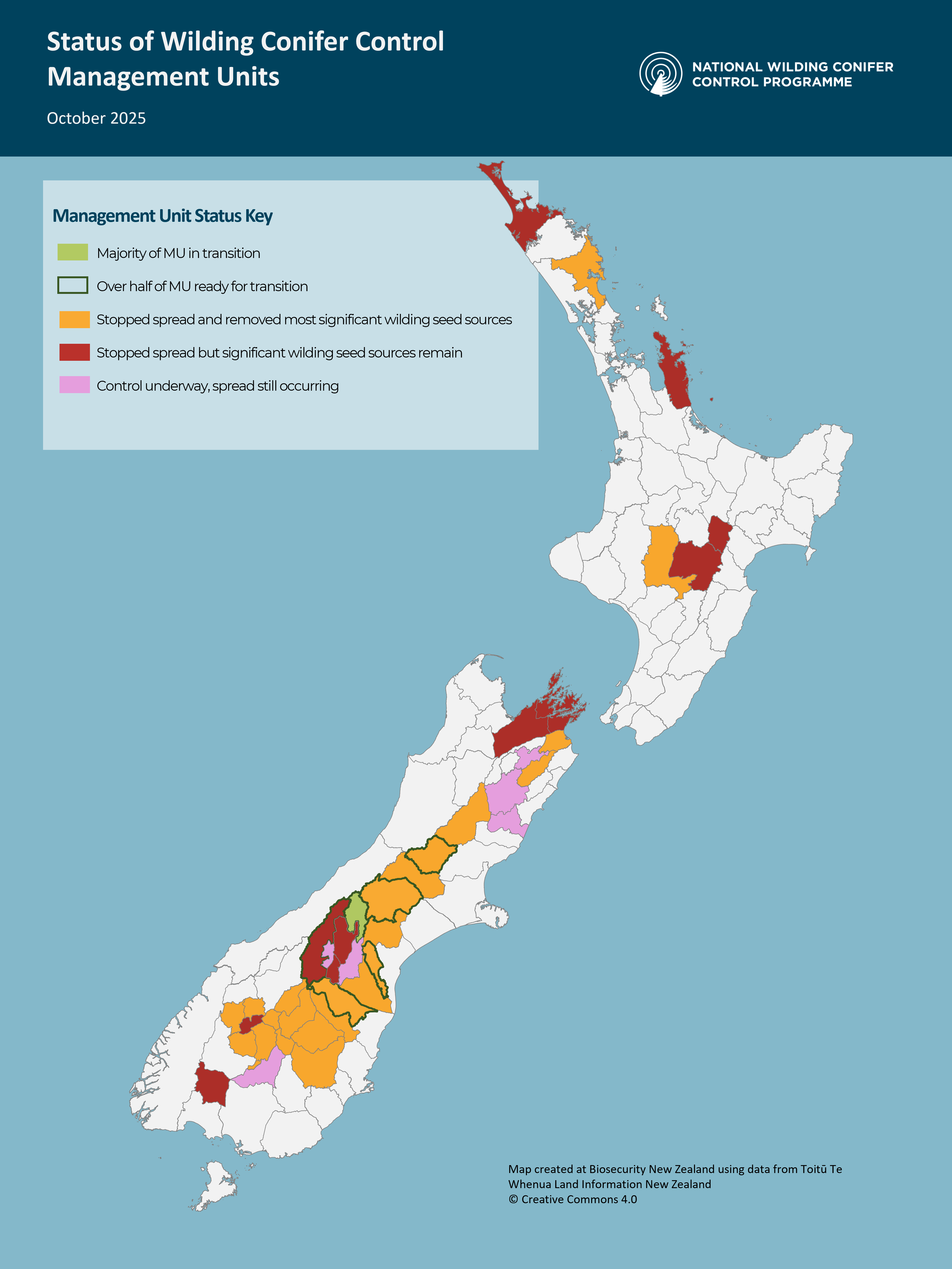
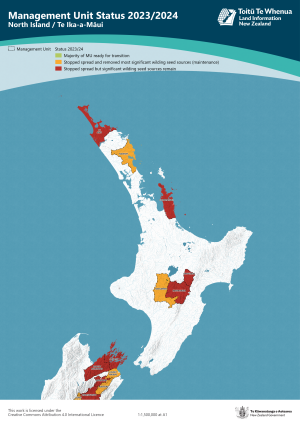
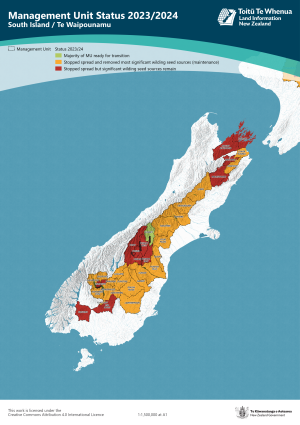
For the purposes of prioritising, planning and coordinating wilding control operations nationally, the Programme has divided the country into geographic areas known as Management Units (MUs). Each MU may have multiple Operational Areas within it - where the wildings are.
To date the Programme has funded control work in 42 MUs, plus funding for specific community-led projects in another 9 MUs. There is a set of agreed criteria for prioritising control work.
Maintenance just means the required follow-up control work that is needed once initial control work has been undertaken. The focus of maintenance operations are the same as initial control - removing any new emerging seedlings before they cone, and removing or neutralising (e.g. with herbicide) any remaining coning wildings. Maintenance starts once most coning wildings are deal with, and is needed in three-yearly phases, for at least two or three cycles, until seeds in the soil have been exhausted.
In areas where maintenance is due, but cannot yet be carried out through the Programme’s current funding, we refer to this as deferred maintenance. These areas are still a priority for the Programme and will be included in the next annual prioritisation and planning process.
The Programme's approach is to support wilding control work, including maintenance rounds, until the level of ongoing maintenance needed is reasonable for the landholder to start to take responsibility for. The process of transition planning can start, for an entire MU or part of an MU, once the level of re-infestation is manageable, taking into account seed sources that may still exist, and maintenance costs are reasonable. There are many variables within each MU and situation, so the process involves the council and the landholder(s) working together and considering all the factors.
The Godley MU in the Northern Mackenzie Basin was one of the first places where the National Wilding Conifer Control Programme delivered control operations, and it is now at the stage of transition. In 2024/25, Environment Canterbury and landholders in the Godley MU worked through a pilot of the transition planning process, to test the framework and guidance that has been drafted with input from regional programme partners. Thanks to a positive collaboration with these landowners, this transition pilot is considered a success. The guidance will be refined and trialled in other Management Units. The guidance and a report on the pilot will be made available soon - feel free to request it from wilding.pines@mpi.govt.nz.
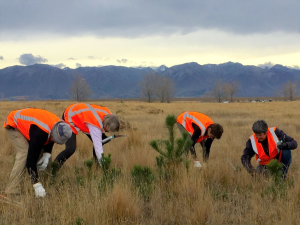
Planning is key to a safe and successful wilding control operation, especially when taking on a large area. Before spending too much time or money, get advice from your regional council, contact a local community trust through the Wilding Pine Network or at least learn about the different control methods.
In the National Programme, Councils create local operational plans for each Management Unit (see above) in their region(s) in collaboration with their local partners. That means working with neighbouring regions on shared MU boundaries, and with local project managers, contractors and other experts. This means understanding the landscape and infestations, assessing the best ways to carry out safe and effective control, and estimating costs.
Annual plans for each MU are then discussed with other regions to agree on the highest priorities. Once a final plan for the year is approved by the programme Governance Group, councils then manage control operations and report back on what gets done.
A national database - the Wilding Conifer Information System or WCIS - is developed and maintained by Toitū Te Whenua Land Information New Zealand. WCIS holds the information collected and reported by all programme partners about infestations in each Management Unit (MU), and every operation carried out. Data includes the wilding tree species at each site, the control methods used, and other details. This data is used for reporting, and planning the next rounds of control.
Government funding for wilding control operations through the National Programme is distributed through Biosecurity New Zealand to the regional partners – regional or district councils. They in turn work with local groups and contractors to carry out control operations in their region.
Local funding, including cost-sharing arrangements with landowners and in-kind contributions to control work are also managed through councils or through community trusts that do a great job of local fundraising.
Read more about funding of the National Programme and how the partners decide on where to target funding for control work.
Join or start a community group - contact the Wilding Pine Network.
The Wilding Pine Network is a key partner in the National Wilding Conifer Control Programme, working to support community-led efforts to manage wilding conifers (wilding pines). Visit their website to see if there is a group near you, or find out how to start one.
Part of a club? How about an informative presentation on wilding pines at your next event? We can provide information resources, giveaways and prizes to get people engaged. Share or present these videos and animations.
All the resources on this website are available free - either download them or email wilding.pines@mpi.govt.nz to request copies for sharing.
Sponsor community projects and help spread the word – ask us for copies of our information brochure to distribute or download a printable copy.