
November 2026: The project to develop an NPMP for wilding conifers is in early stages - gathering information, identifying groups that need to be involved, and high level analysis of what the NPMP needs to do and include.
Once the refreshed national strategy is finalised, which is expected to be shared in early 2027, detailed engagement will get underway with key stakeholders.
See below for answers to common questions about NPMPs in general and the work on an NPMP for wilding conifers.
There will be a formal public consultation process once detailed proposals have been prepared. Timing will be shared once initial high-level analysis has been completed, and information will be on the MPI website.
What is a National Pest Management Plan and what can it do?A National Pest Management Plan is a regulatory tool, under the Biosecurity Act 1993, for solving severe pest problems that pose significant risks to New Zealand. New Zealand has four existing NPMPs, for Mycoplasma Bovis , Kauri protection, Bovine tuberculosis, and American Foulbrood. An NPMP can:
More information: Part 5 of the Biosecurity Act 1993 sets out in detail what an NPMP can include, and what must be included. |
What does the process for developing an NPMP involve?The Biosecurity Act 1993 sets out specific steps and requirements* for developing and adopting an NPMP. At key stages through the process, approval from the Minister for Biosecurity and/or Cabinet is required. The process in summary: Investigate the problem and options with stakeholder input → develop proposals → consult → review and update → establish and implement any approved plan. The work is in the first stage, focused on understanding and analysis of the issues from varied perspectives, stakeholder engagement, and sourcing independent evidence of benefits and costs. *Part 5 (sections 59–67) of the Biosecurity Act 1993 | New Zealand Legislation, five statutory steps for making an NPMP. |
How does an NPMP work with existing rules related to the same pest?An NPMP must take existing rules into account, and set out how they will work alongside each other, if necessary. Councils are able to set stricter or wider rules than an NPMP in their Regional Pest Management Plans (RPMP) or District Plans (but not lesser rules). To see current settings for wilding conifer species within current Regional Pest Management Plans, visit the relevant regional council website or use the New Zealand Established Pests Portal on the MPI website. |
How are funding or cost-sharing decisions made under an NPMP?Under Part 5 of the Biosecurity Act 1993, in order for a proposed NPMP to be finalised and implemented, the sources of funding must be identified, and there should be adequate funding for the first five years. An NPMP can provide for the allocation of costs to different groups to support this funding, based on a structured assessment of activities that benefit from the plan or contribute to the problem. Funding arrangements must be efficient, effective, equitable and practical to implement, and there must be public Consultation before any final decisions are made. |
Why is the Government developing an NPMP for wilding conifers?Despite significant progress through the National Wilding Conifer Control Programme, some current rules, plans and policies (national and regional) do not support effective wilding conifer management. Problem seed sources remain, and vulnerable landscapes are still threatened. The Minister of Biosecurity has directed MPI to develop an NPMP, in order to strengthen the existing national coordination and support effective control, through clear, consistent national rules. |
How does the National Pest Management Plan relate to the National Wilding Conifer Management Strategy and the National Programme?
|
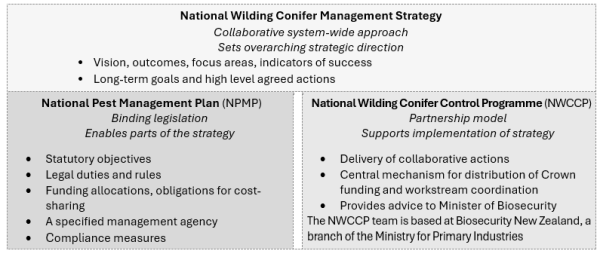
|
What will be included in the NPMP for wilding conifers?The details won’t be known until the process is complete, but aspects to be explored are:
|
How will the NPMP affect landowners?It is too early to say how an NPMP will affect landowners, but proposals will be developed based on evidence. Biosecurity New Zealand will be seeking views from affected landowners to help define the challenges and how they can be addressed through an NPMP. Wilding conifers and their management are substantial issues for many types of landowners and managers, whether their land use involves planted exotic conifers or is affected by wildings, or both. This includes primary producers, rural lifestyle residents, Crown agencies that manage land, and collective landowners such as Iwi and Hapū. It also includes owners / managers of land with exotic conifers, whether in shelter belts, wood lots, amenity plantings, or commercial forests. |
Could an NPMP restrict planting or require existing trees to be removed?Exactly what will be included in the NPMP is yet to be worked through. Specific management or removal requirements are among the matters that may be considered during development of the NPMP. No decisions have yet been made about particular land use activities, conifer species, or circumstances that would be subject to rules. |
Who will be developing the NPMP for wilding conifers?
|
How will foresters and farmers be involved in the NPMP development?Biosecurity New Zealand (MPI) will engage with farmers, foresters and other sectors on the NPMP, in addition to taking into account the feedback received on the refresh of the National Wilding Conifer Management Strategy. Wilding conifer management is already delivered through strong partnerships with the primary industries. Federated Farmers and the Forest Owners Association are partners in the National Wilding Conifer Control Programme Governance Group. Many individual farm and forest owners contribute directly to wilding conifer management, on their own properties and/or in their wider communities. Those partnerships will continue to be important as proposals are developed and once an NPMP is implemented. |
How will Māori be involved in the NPMP development?Biosecurity New Zealand (MPI) will continue engaging with interested Iwi, Hapū, Rūnanga and other Māori organisations on the NPMP. Feedback already received on the refresh of the National Wilding Conifer Management Strategy will also be considered. Substantial wilding conifer control is already delivered through Iwi-led projects and organisations and Māori-owned companies, often as part of wider whenua protection and restoration mahi. Input from these groups will be important as proposals are developed and once an NPMP is implemented. |
How will communities be involved in the NPMP development?Communities have been key contributors to wilding conifer control for many decades and are essential partners in the National Wilding Conifer Control Programme. Community groups and individuals will have opportunities to input into the process, including:
|