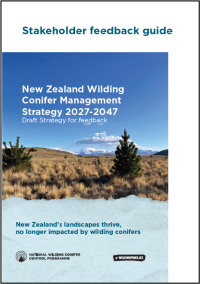
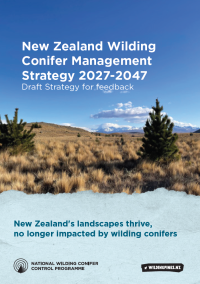
The National Wilding Conifer Control Programme Governance Group is inviting feedback from the wilding conifer control community and stakeholders on the draft of a refreshed national strategy for wilding conifer management in New Zealand.
The draft strategy was informed by contributions from across the wilding conifer community. This included review of background information, discovery interviews with representatives of key groups involved in wilding conifer management, workshops open to all interested parties, and hui with iwi and hapū representatives. Together, these engagements brought a wide range of perspectives from across Aotearoa New Zealand that helped shape the strategy.
Key themes from these are captured in the Pre-draft Discussion Document and Summary of workshops and hui.
The process was overseen by the Governance Group and a dedicated Strategy Working Group, comprising representatives from a broad cross-section of organisations and interests.
After this, all feedback will be collated (excluding any personal information) and shared with Andrew Harrison, who has drafted the strategy. He will review and analyse the feedback and then revise the draft into a final strategy. We expect the Governance Group to endorse the final Strategy by the end of 2026, and for it to be published in early 2027.
Online at: Wilding Conifer Draft Strategy feedback form
The online form presents questions about the Strategy - you can enter a ranking of how much you agree (or disagree) with key statements, and you can enter written feedback. The form is anonymous and includes information about how your feedback will be collected, used, and protected. The Privacy statement provides more information about this.
By email: wilding.pines@mpi.govt.nz
Feel free to just send an email with your comments. Some questions are provided below to prompt your thoughts, or use this Word template (click the link to download the template) to draft your thoughts. Please note: Emailed feedback is not anonymous.
We want to find out how much you agree or disagree with key statements that explore your view on components of the draft strategy and and we want any additional written feedback on how the draft strategy can be strengthened.
1. Do you agree with the explanation of what has been achieved and learned since the previous strategy?
2. Do the current challenges and opportunities described accurately reflect the situation today?
3. Does the vision describe the future state New Zealand should be aiming for by 2047?
4. Can you see how your mahi (work) or organisation contributes to achieving this vision? Which parts resonate most strongly and what should be strengthened?
5. Are the proposed goals the right priorities for moving New Zealand towards the vision? Should any goals be added, removed or changed?
6. Do the proposed actions address the most important opportunities, risks, and challenges facing wilding conifer management?
7. If the focus areas are successfully implemented, will the vision be achieved?
8. Will the proposed success factors will help track progress and success? Should any success factors be added, removed or redefined?
9. Are the proposed measures are the right things to monitor progress and are they practical to measure?
10. What are the greatest risks or barriers to successful implementation of the strategy?
11. Overall, does the strategy provide a clear and credible direction for wilding conifer management over the next 20 years?
12. Are the roles and responsibilities for all involved clearly defined and appropriate?
12. Do you have any general comments, either to endorse the draft strategy, or to strengthen it, or highlight areas needing more consideration?
If you would like to let us know what sectors(s) of the wilding conifer community you are part of, what you do and what region you are based in, this may be helpful context when analysing your feedback. It may allow us to compare views between regions and sectors.
Below is a summary of the structure of the document.
There is an introduction that sets out the context for the refreshed strategy, including what has been achieved since the original strategy in 2014, and key foundational lessons that are part of the thinking behind this draft strategy.
The vision statement is a brief description of what we want to see when we look at New Zealand’s landscapes and land management systems in 20 years’ time. It’s an imagined picture of the future we want. A vision should be aspirational, future focussed and grounded in reality.
The vision is what the strategy drives towards.
The strategy sets out the outcomes that wilding conifer management contributes to (the ‘why’ we do it), and goals for wilding conifer management (the ‘what’ we need to do) to reach the vision.
The focus areas and actions within these describe in general terms the work that needs to be done to strengthen wilding conifer management and help us move together towards the vision.
The success factors and measures are tangible evidence we can look for and monitor, to know that we are heading in the right direction.
Strategy implementation is outlined, including governance arrangements, the roles of key participants, and development of a National Operational Plan that translates the strategy and future national pest management plan objectives into coordinated delivery.
If you choose to enter any personal information (e.g. name, organisation, email) in the linked form or through an email, we will use it only for the purpose of collecting your feedback and communicating with you about it.
All responses you provide will be accessed only by Biosecurity New Zealand/MPI staff and Andrew Harrison, for the purpose of reviewing and refining the Strategy (or where required or permitted by law).
We will store and manage your information in accordance with the Privacy Act 2020 and the Ministry for Primary Industries’ information management policies.
The information will be retained only for as long as necessary to meet legal, operational, and record-keeping requirements.
You have the right to request access to, and correction of, any personal information we hold about you. To do so, please contact us at privacyrequests@mpi.govt.nz.
For more information about how we collect, use, store, and disclose personal information, please see our Privacy Policy: Personal information use and disclosure and How we keep personal information safe and secure https://www.mpi.govt.nz/about-this-site/privacy-and-security